When did you last review how you fund your employee car scheme?
Established arrangements deserve scrutiny, particularly when the costs and assumptions behind them may have changed.
For a manufacturer, an internal car scheme should be considered as a commercial tool, generating a planned supply of nearly new vehicles for its dealer network; with employee participation, vehicle choice and replacement cycles all influencing the volume, mix and timing of that supply.
But as an employee benefit, the scheme must also give employees affordable access to the brand’s vehicles, whilst supporting product familiarity and encouraging EV uptake.
Scheme funding, therefore, requires a shared vision across finance, HR, fleet and remarketing, because it must support those objectives while remaining financially sustainable for the manufacturer.
Look beyond the monthly contribution
Employee car ownership (ECO) schemes, where staff own vehicles for a relatively short period before resale, have long helped manufacturers meet these objectives.
Assessing their commercial effectiveness requires a holistic financial picture. That’s funding costs, expected resale proceeds, tax treatment and reporting, protection against inherent risks and administrative burden, as well as employee contributions.
Whilst leaving employees’ net monthly costs unchanged, an alternative funding structure could produce a materially different financial outcome for the business.
Meanwhile, increasing employee contributions may improve the manufacturer’s position, but could reduce participation or narrow vehicle choice, affecting the volume and mix of cars available to dealers.
A review should therefore start by agreeing what the scheme needs to achieve and how success will be measured.
Compare alternatives on consistent terms
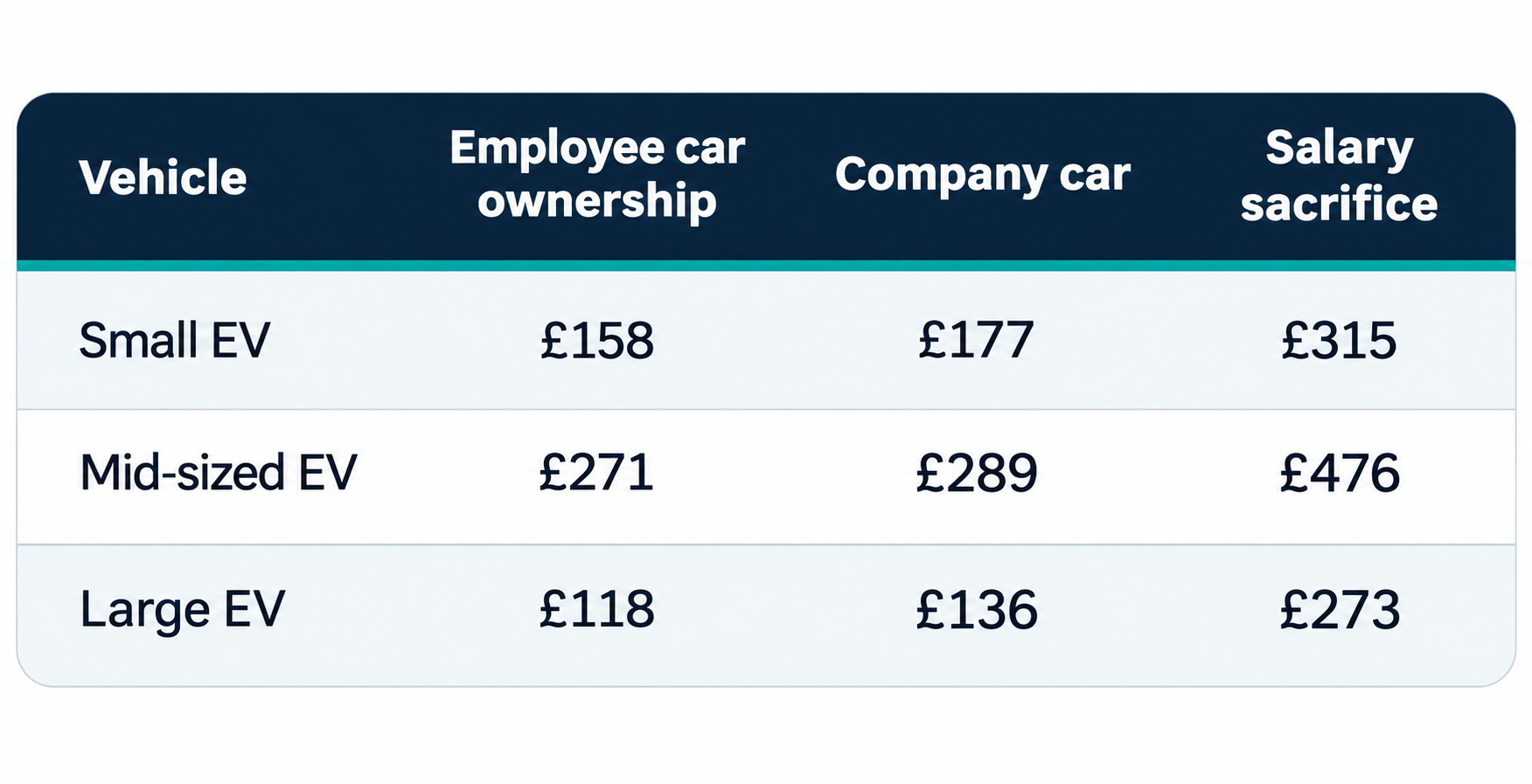
In a recent assignment for a leading European manufacturer, BCF Wessex Consultants compared ECO, traditional company cars and salary sacrifice across several electric models.
The principal comparison held employees’ net monthly costs at the same level as the existing ECO scheme, providing a consistent basis for assessing the manufacturer’s financial position.
Salary sacrifice delivered the strongest short-term financial outcome across all models, as highlighted below.
Test the position over time
Today’s optimal funding structure may not remain the best over time.
Lower resale proceeds, tax changes or a different replacement cycle can alter scheme costs, employee affordability or the timing of dealer supply.
Manufacturers should therefore test realistic scenarios over the medium to long term and allow time to prepare for changes that will fundamentally affect established schemes.
In our review, future scenarios showed that ECO could regain a financial advantage for some models as BiK tax rates increase. However, fundamental changes to the taxation of ECO cars, which become subject to BiK charge from April 2030, means any resurgence should be short-lived.
The intervening years are therefore crucial, offering manufacturers the chance to plan their transition.
Make the numbers work in practice
Manufacturers should review their internal car schemes now, allowing time to assess alternatives and introduce changes over the next few years. That starts with establishing the scheme’s current cost, clarifying its commercial purpose and comparing credible alternatives.
Operational practicality matters too. A financially favourable solution may prove difficult to justify if it requires disproportionate administration or frequent changes that employees struggle to understand.
A phased transition could begin with salary sacrifice for EVs while preparing for longer-term changes affecting ECO cars, which could limit the options available for PHEVs when new ICE cars can no longer be sold in 2030. Funding decisions should reflect employee affordability, replacement cycles and the continued supply of nearly new vehicles to dealers.
Finance, HR, fleet and remarketing teams should agree how and when changes will be introduced, with clear communication to employees throughout. The aim is to prepare the scheme for the coming decade, with a transition plan established well before 2030.